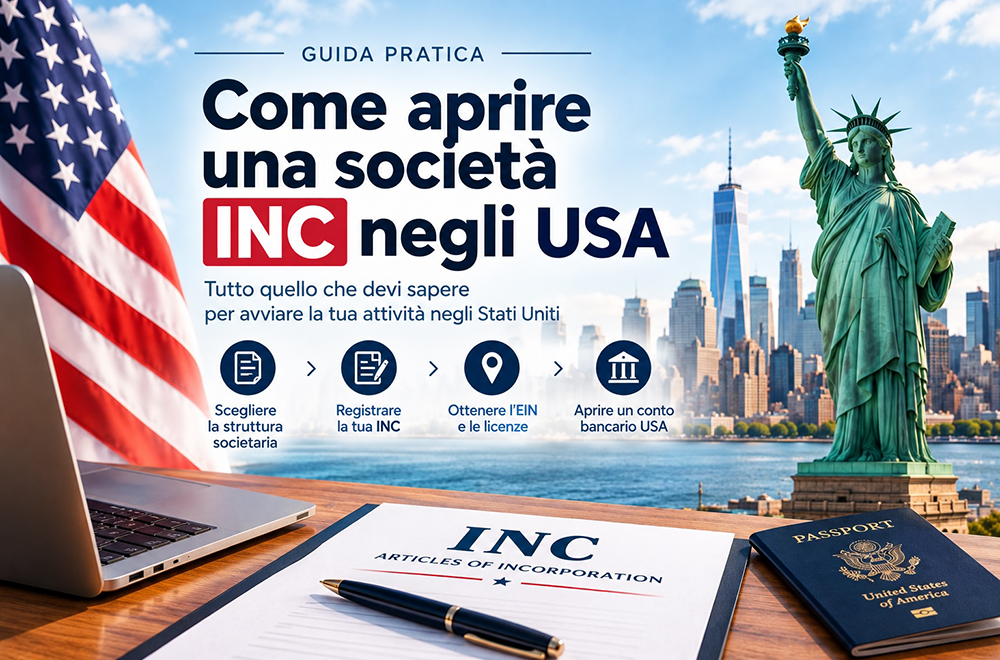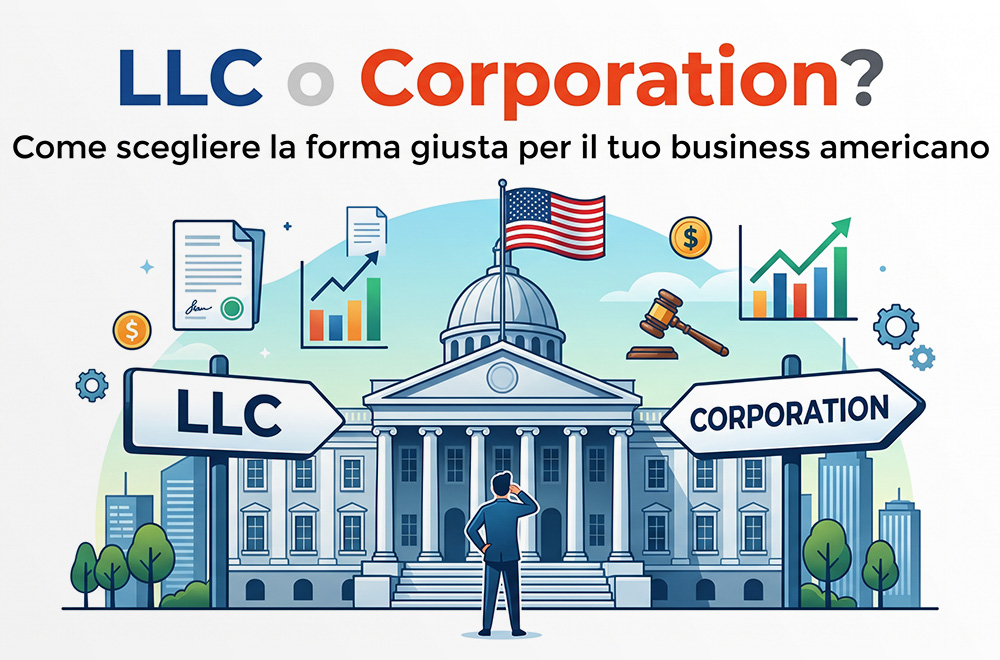
When an Italian entrepreneur decides to open a company in the United States, the first concrete question is almost always the same: LLC or Corporation? It looks like a technical choice, but it has very practical consequences for taxes, management, the ability to raise capital and — often overlooked — your tax position back in Italy. It is also the most common mistake we see: choosing the form “because that’s what an acquaintance did”.
This article expands on one point of our full guide: Opening a Company in the USA →
What an LLC (Limited Liability Company) is
The LLC is the most flexible, streamlined form in the American system. It offers limited liability (the members’ personal assets are separate from the company’s) with light management and few formalities. For tax purposes it is, by default, “pass-through”: the company pays no tax of its own; profits flow directly to the members, who report them.
It is often the right choice for operating businesses, service companies, e-commerce and structures with few owners that don’t plan to raise capital from investment funds.
Strengths: flexibility, simple management, no double taxation at the US level.
To consider: for a non-resident owner, an LLC still carries specific US filing obligations, and the “pass-through” treatment must be coordinated with Italian rules to avoid surprises.
What a Corporation (C-Corporation) is
The Corporation is a separate legal entity, with shares. It is in practice the required form if your goal is to raise capital from US investors or venture capital funds, which almost always want to invest in a C-Corp (typically incorporated in Delaware).
In exchange for greater “bankability”, it requires more formal governance (board of directors, minutes, filings) and, on the tax side, profits are taxed at the corporate level and again in the shareholders’ hands when dividends are distributed.
Strengths: the standard for those seeking investors, with a scalable structure and highly predictable rules.
To consider: more formalities and two-level taxation, which bites if profits are distributed rather than reinvested.
The S-Corporation trap
Watch out: the “S-Corporation” is often cited as a way to avoid double taxation. But an S-Corp requires the shareholders to be US persons: for an Italian entrepreneur it is not a viable option. If someone proposes it without asking about your residence, that’s a red flag.
The right questions to decide
Rather than a fixed rule, you need answers to a few key questions:
- Do you want to raise capital from US investors or funds? If so, the C-Corp (often in Delaware) is almost mandatory.
- Who are the owners and where do they reside? The owners’ tax residence radically changes the picture.
- Will profits be distributed or reinvested? Reinvesting reduces the weight of the C-Corp’s double taxation.
- Is it an operating business or a holding company? The purpose changes the ideal structure.
- What exit do you envisage (sale, listing, succession)? Choose the form with the ending already in mind.
Don’t forget the Italian side
This is the most underestimated aspect. A structure optimised only “on the US side” can trigger unwanted consequences in Italy, tied to tax residence, controlled foreign companies and the double taxation treaty. The right form is the one that works on both sides of the ocean — and that is exactly where a firm with dual Italy-US qualification makes the difference.
In short
Rule of thumb: an LLC for most operating businesses with few owners; a C-Corp if you’re aiming at investors and scalable growth. But the decision must always be fitted to your case and coordinated with Italian taxation before you incorporate — not after.
Not sure which form to choose for your US project?
In a first consultation we review your goals, owners and taxation together to identify the right structure, before you spend.
Or write to us at p.franzo@paolofranzo.com · +39 02 5519 2653